
Tell us the problem you want to solve
Thank you. We have your message and will reply within one business day.
Implementing Prescribe to fine-tune Siemens AXI measurement thresholds
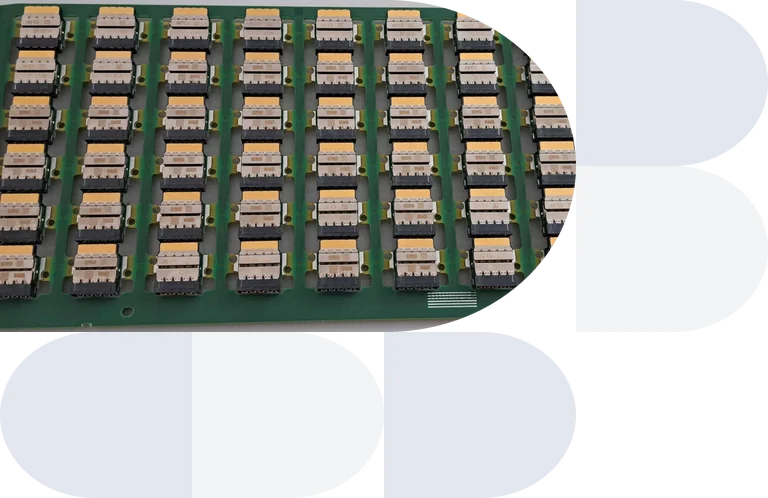
Siemens asked whether AI could tell it something new about the X-ray inspection of circuit boards at its electronics factory in Amberg, Germany, where quality rates were already high. On the historical inspection data, the test routine proposed by DataProphet's algorithm cut the false call rate by 64%, against the routine set by Siemens' process experts.
Good parts flagged as faulty
The plant's automated X-ray inspection (AXI) measures every pin on a panel of 48 boards, about 150,000 measurements per panel, against thresholds set by Siemens' process experts. The overall defect rate was very low, but the false call rate, the rate at which good parts are flagged as faulty, was around 70% in FY 2019. Each false call lowers first pass yield and adds manual inspection time.
Loosening a threshold has a cost too. A slip, a faulty part passed as good, costs Siemens about ten times as much as a false call. So the team tuned the X-ray stations by hand to reduce false calls while avoiding slip, between production runs or when the input material changed.
The false calls were concentrated. Some individual pins had false call rates as high as 96.8%, and the twenty worst pins accounted for nearly half of all false calls.
Thresholds tuned from the inspection history
The data
Our team met the Siemens team on site in Amberg in May 2023, and Siemens shared its X-ray inspection database. For each flagged pin, it records the measurements and the operator's verdict on whether the pin was really faulty.
The level of detail
Thresholds were set per pin and kept the same across all boards on a panel. Some line numbers had far more false calls than others, so we considered two levels of detail: thresholds per pin, and per pin and line. We used DataProphet Prescribe for dimensionality reduction, to find the level of detail at which each threshold needed to be defined.
The tuning method
We then tuned the thresholds at each level with a local random optimisation algorithm, a derivative-free method customised for this application, scoring each candidate threshold with a loss function. The method suited this problem because it is robust and sample-efficient, and it converges well when it starts close to the true optimum, as it is here, where each search starts from the pin's historic threshold.
An operator cockpit
Siemens and DataProphet set up a continuous data flow from the shop floor to a shared cloud, and an operator cockpit in DataProphet Connect that shows false call rates per pin, board and line, so that the algorithm can give new recommendations when needed.
On Siemens' historical inspection data
| Measure | Result |
|---|---|
| False calls on the 66 pins with improved thresholds | 64% fewer |
| False calls across all pins, unchanged pins included | 38% fewer |
| Tuned thresholds against the experts’ thresholds, full historical dataset | At least as good |
| Thresholds tuned per line number, where the data supported it | Further improvement |
Fewer false calls mean fewer pins for an operator to re-check by hand. The same approach applies to any other AXI machine with a detailed enough inspection history.
“On the dataset, the test routine proposed by the algorithm achieved a 64% reduction in false call rates for the X-Ray testing and benchmarked on a test routine created by our skilled Process Experts!”